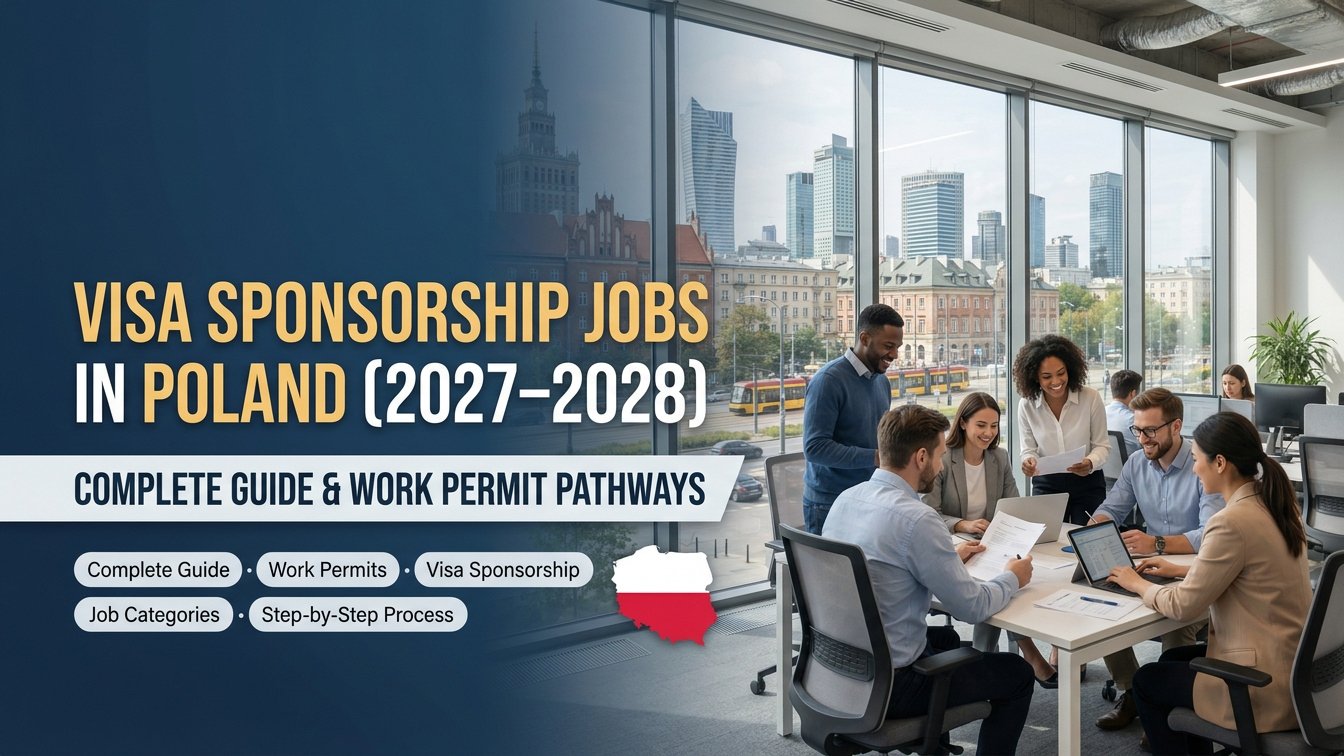
Poland remains one of Central Europe’s strongest destinations for international talent heading into 2027 and 2028. Driven by expanding technology hubs, industrial manufacturing, logistics, and infrastructure investment, Polish employers actively sponsor non-EU professionals and skilled tradespeople.
Because Poland transitioned to a fully digital immigration workflow and updated its statutory wage floors, understanding the latest salary thresholds, permit categories, and application rules is essential before applying.
Quick Job Overview (2027–2028)
- Country: Poland (Primary hubs: Warsaw, Kraków, Wrocław, Gdańsk, Poznań, Katowice)
- Employment Type: Full-time permanent or fixed-term employment contracts (umowa o pracę)
- Work Model: On-site for manufacturing, logistics, and hospitality; hybrid or remote options widely available in IT and finance
- Minimum Statutory Salary (2027): PLN 4,950 gross/month (PLN 32.30 gross/hour), with an annual upward adjustment scheduled for January 2028
- Work Authorization: Employer-sponsored Type A Work Permit, EU Blue Card, or Temporary Residence and Work Permit
High-Demand Sectors Offering Visa Sponsorship
Polish companies across several expanding industries regularly sponsor foreign workers:
- Information Technology & Software: Software developers, cybersecurity analysts, cloud engineers, DevOps specialists, and data scientists.
- Engineering & Construction: Civil, mechanical, electrical, and automation engineers supporting energy and transport infrastructure.
- Manufacturing & Logistics: Automotive assembly, pharmaceuticals, machinery technicians, CNC operators, warehouse supervisors, and heavy-goods drivers.
- Finance & Shared Services: Financial analysts, accountants, risk specialists, and multilingual corporate operations staff.
- Healthcare & Life Sciences: Physicians, nurses, pharmacists, and clinical research specialists (subject to Polish medical licensing).
- Hospitality & Education: Hotel management, tourism coordinators, and qualified native or near-native English instructors.
Eligibility & Sponsorship Requirements
Poland’s work permit system is employer-driven—you must secure a binding job offer before your employer initiates sponsorship:
- Valid Job Offer: A signed employment contract or formal job offer from a company registered in Poland.
- Relevant Qualifications: A university degree, vocational diploma, or documented multi-year work experience matching the role.
- Salary Compliance: Offered pay must meet or exceed the statutory minimum wage (PLN 4,950 gross/month in 2027) and match comparable local wages for the same position.
- Language Skills: English is standard in international IT, finance, and shared-service centers, whereas Polish proficiency is generally required for local healthcare, customer-facing, and public-sector roles.
- Clean Legal & Health Standing: A valid passport (with full page scans required for digital filing), clean criminal record certificate, valid health insurance, and confirmed accommodation in Poland.
Work Permit Pathways & 2027–2028 Rules
Under Poland’s modernized immigration framework, all work permit filings are processed 100% online via praca.gov.pl, and temporary residence applications are submitted electronically through the MOS portal:
| Permit Pathway | Who It Is For | Key Features (2027–2028) |
| Type A Work Permit | Non-EU workers hired directly by a Polish company | Valid up to 3 years; the former labor market test (opinia starosty) has been abolished, though districts may restrict locally protected roles. |
| EU Blue Card | Highly qualified specialists with a higher-education degree | Requires a minimum 1-year contract and a salary of at least 150% of Poland’s average national gross wage; counts toward EU long-term residence. |
| Simplified Declaration (Oświadczenie) | Citizens of Armenia, Belarus, Moldova, and Ukraine | Fast-track employer registration valid for up to 24 months. |
| Single Residence & Work Permit | Non-EU nationals already legally residing in Poland | Combines legal stay and work authorization into one residence card (Karta Pobytu). |
(Note: Citizens of EU, EEA, and Swiss member states do not need a work permit and only need to register their residence if staying longer than 3 months.)
Salary Benchmarks & Cost of Living (2027–2028)
Effective January 1, 2027, Poland’s statutory minimum wage rises to PLN 4,950 gross per month (up from PLN 4,806 in 2026), with another statutory increase slated for 2028. However, salaries for sponsored skilled roles are typically much higher:
- Entry-Level Logistics / Manufacturing / Hospitality: PLN 5,000 – 6,800 gross/month
- Skilled Technicians & Trade Specialists: PLN 7,000 – 10,500 gross/month
- Finance, Engineering & Corporate Analysts: PLN 9,500 – 15,000+ gross/month
- Senior IT & Software Engineering: PLN 16,000 – 28,000+ gross/month
Gross pay in Poland includes mandatory social security (ZUS) and income tax withholdings, meaning net take-home pay is typically around 70%–75% of gross salary depending on age and tax relief eligibility.
Benefits of Working in Poland
- Full Legal & Social Security Coverage: Sponsored employees receive state healthcare access, pension contributions, and paid sick leave through ZUS.
- Generous Paid Leave: Workers are entitled to 20 or 26 days of paid annual vacation (depending on total education and career tenure) plus public holidays.
- EU Career Mobility: Holding a valid Polish residence card allows visa-free short-term travel across the Schengen Area and builds European work credentials.
- Balanced Living Costs: While housing in Warsaw and Kraków has risen, everyday groceries, public transit, and utilities remain more affordable than in Western Europe.
Step-by-Step Application Process
- Prepare an EU-Style CV: Create a concise, 1–2 page CV highlighting measurable achievements, technical certifications, and language levels.
- Apply Through Verified Polish Job Boards: Search English-friendly and international-hiring roles on Pracuj.pl, No Fluff Jobs (for IT), Just Join IT, LinkedIn, and EURES.
- Confirm Employer Sponsorship: During interviews, verify that the employer is ready to submit an electronic work permit application via praca.gov.pl and upload your signed contract before your start date.
- Apply for a National D-Type Visa: Once your work permit is approved, book an appointment at the nearest Polish consulate or visa application center with your permit, passport, insurance, and accommodation proof.